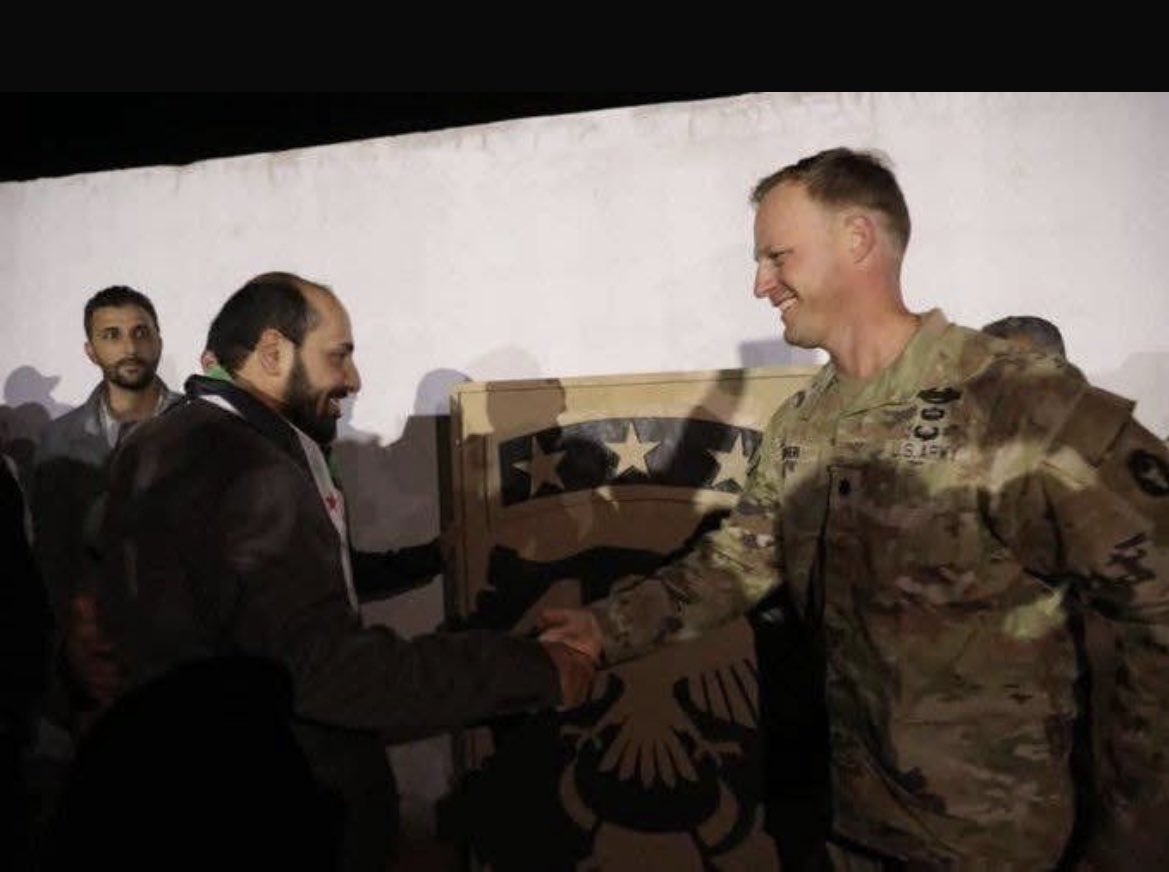
Image courtesy of Mahir Engizek
Modern Western strategic thinking still likes to present itself as the child of the Enlightenment: Rationality, progress, order, and law.
However, the practice operating in the Middle East for the past 30 years has repeatedly shown that these concepts are nothing more than a normative mask, an ideological camouflage. What is being marketed today as “moderate jihadism” is neither an exception nor a tactical mistake. On the contrary, it is one of the most consistent products of the imperial mind’s relationship with violence.
The bloody attack in Palmyra is the inevitable outcome of this consistency. This event is not an accident but the manifestation of a systemic moral and strategic decay.
The concept of “moderate jihadism” is theoretically an oxymoron. Jihadism is fundamentally built upon an ideology of absolute hostility towards Western modernity, secularism, women’s liberation, and pluralism.
The only thing that makes this ideology “moderate” is the West’s temporary tolerance of it, its attempts to steer it, and its integration into its own architecture of violence for the sake of its transient interests. Hannah Arendt’s concept of the “banality of evil” gains a strategic context here. Evil is no longer the pathological deviation of fanatics but the byproduct of the cold, calculated assessments of bureaucratic logic.
The policy pursued by the US and its allies in Syria is, in this context, not an exception but a continuation of a long line stretching from Iraq to Afghanistan, Libya, and Yemen.
The “controlled chaos” doctrine is the name for the contradiction between the West’s fetish for order and its practice of generating chaos. Chaos here is not a failure, but a consciously produced strategic environment designed to weaken rival actors, fragment the social fabric, and prevent the flourishing of alternative political projects. However, the assumption that this chaos is “controllable” is the most dangerous delusion of imperial narcissism.
Viewed through Michel Foucault’s lens of the power-knowledge relationship, the distinction between “moderate” and “radical” is not an analytical tool defining the reality on the ground, but a discursive construct produced by the West to legitimize its own interventions.
Organizations like Hay’at Tahrir al-Sham (HTS) have been temporarily reframed within this discourse as “transformable,” “rational interlocutors,” or “the lesser evil.” This is not an act of ignorance but a deliberate political choice. Because for the West, the real threat is not the armed jihadist groups, but the possibility of a democratic project rooted in the people, which is secular, pro-women’s liberation, and anti capitalist.
It is precisely at this point that the model put forth by the Kurdish Freedom Movement in Syria exposes the structural limits of the Western mind.
This project, centered on democratic self-administration, Democratic Societal Socialism, communal economy, and gender liberation, is not merely a military success against ISIS (Daesh) but also an alternative civilizational vision for the region. This vision undermines the West’s binary schema that confines the Middle East between authoritarian nation-states and armed jihadist structures. This is why the Syrian Democratic Forces (SDF) has never been a “fully trustworthy” partner for the Coalition.
This seemingly paradoxical situation is, in fact, highly rational. The SDF is too consistent, too principled, too autonomous. What the West seeks is not actors who genuinely embody its values, but structures that verbally assent to those values while practically agreeing to be part of the imperial order. HTS’s performance of “moderation” was encouraged precisely because it answered this expectation.
But ideologies do not behave like mercenaries. As Frantz Fanon warned, alliances established through violence eventually turn against their own masters. Jihadism is not domesticated as it is instrumentalized; rather, its ideological core is hardened. Every contact with the West deepens the internal contradictions of this ideology and ultimately produces a “moment of betrayal.” The attack in Palmyra is the crystallized form of this moment of betrayal.
The reactions of US and Coalition officials following this attack have made the collapse even more visible. The reflex to quickly pin the blame on ISIS is not just a propaganda maneuver but an expression of an inability to face the truth.
Because the attack having originated from within HTS demolishes the entire “moderate partner” narrative. This situation creates a rift in the discursive universe established by the West. The truth, which has been attempted to be suppressed, is emerging bloodily.
The real object of scrutiny here should not be a singular attack, but the structural mindset that made this attack possible. Why has the Coalition consistently kept the SDF—the most reliable, disciplined, and ideologically consistent force on the ground—under pressure, while seeing an entity like HTS as a strategic option for “key leader engagement”?
This question is not just military or diplomatic; it is a profound moral question. And every evasive answer to this moral question paves the way for new Palmyras.
The myth of “moderate jihadism” has collapsed at this point, not just theoretically, but practically. Controlled chaos is now generating an uncontrollable blowback. The West has been struck from within by the ideological enemy it fed with its own hands, yet it attempts to present this blow as an “unforeseen exception.” However, this is not the exception; it is the rule itself.
Palmyra: The Location of Betrayal, the Collapse of Controlled Chaos, and the Bloody Exposure of the “Moderation” Lie
The Palmyra desert has historically been a geography where empires were tested by their hubris. Just as the stone columns of Rome eventually sank into the desert, today the “smart,” “finely tuned” security architecture the West thought it was building in the Middle East is dissolving among the same desert sands. The attack in Palmyra is, in this sense, not just a military incident but a symbolic breaking point where the strategic lies of an era are being buried.
To read this attack as a mere case of “internal radicalization” is to consciously distort the truth.
Because the attacker’s affiliation with HTS, his direct relationship with the organization’s intelligence structure, and the context in which the attack took place indicate that this was not an isolated aberration, but the product of an organizational and ideological continuity. The only “surprise” here is the Coalition’s audacity to still pretend to be surprised.
The HTS narrative of “transformation” marketed to the West was a security theater from the start. On the stage of this theater, Ahmad al-Sharaa (Muhammad al-Jolani), while trimming his beard and posing with tie-clad diplomats, maintained the organization’s ideological backbone—the Salafi-jihadist worldview—intact.
This dual structure was not a contradiction but a deliberate strategy. The message to the West was: “Legitimize me, and I will be functional against your enemies.” The Coalition accepted this bargain. The price was paid in Palmyra.
The critical point here is the timing and the target of the attack. This was not a blind act of violence aimed at a randomly chosen target. It was a symbolic strike aimed precisely at the relationship the Coalition established with HTS. The message is: “I sit at the table with you, but I am not subordinate to you.” More importantly, this message is directed not only at the Coalition but also at the HTS base. Ideological discipline within the organization is re-established through such actions. Contact with the West leads not to ideological dissolution but to ideological radicalization.
At this juncture, the reflexes displayed by Western media and official discourse are as instructive as the attack itself. The immediate finger-pointing at ISIS is not an intelligence error but a discursive defense mechanism.
Because ISIS is encoded in the West’s mental map as the “absolute evil,” and this code is useful for externalizing responsibility. HTS, however, is an actor the West wishes to keep in the gray zone—a “transformable” entity. The fact that the truth does not fit the ISIS narrative is therefore disconcerting.
This discomfort is evident in the statements by Trump and other Western officials. Expressions such as the attacker’s leader (Ahmad al-Sharaa) being “angry” are not political analysis but psychological reduction. Linking an ideological attack to individual emotional states obscures both the responsibility and the structural flaw. This language reveals the extent to which the West avoids questioning the architecture of violence it built.
The statement by the HTS Ministry of Interior spokesperson, admitting that the attacker had “extremist tendencies,” is the tragicomic climax of this theater. This confession reveals that the Coalition is unable to cope not only with external threats but also with the internal dynamics of the very structure it is in direct contact with. To put it more clearly: The Coalition knows who it is sitting with, but chooses to pretend otherwise. This choice is not a strategic error but a deliberate gamble.
Behind this gamble lies the regional legitimacy collapse deepened by the Gaza crisis. The US and its allies have already suffered a severe loss of legitimacy in the Arab and Muslim world due to their stance on Gaza. In this atmosphere, the anti-Western and anti-Zionist anger rising from the base of structures like HTS is not a variable that can be controlled. On the contrary, this anger is the main fuel for ideological mobilization. The Palmyra attack is one of the first major explosions of this fuel.
Here, Joe Kent’s description of the attack as a “terrorist act carried out from the inside” is one of the rare statements that inadvertently approaches the truth.
Yes, this is an inside attack. But the “inside” is not just the body of HTS, but the sphere of the dirty alliance established by the Coalition itself. The betrayal did not infiltrate from the outside; it blossomed from a structure that the Coalition was in contact with, legitimized, and indirectly empowered.
At this point, the real tragedy is that the Coalition still views this event as a “manageable crisis.” Threats of retaliation, the “we will hunt them down” rhetoric, and limited military operations are being substituted for a strategic confrontation. The problem here, however, is not a target to be hit, but a mindset that must be abandoned. Jihadism is not an external threat that can be eliminated by bombing; it is an ideological ecosystem nurtured by faulty alliances.
And against this ecosystem, there is only one structure that has consistently stood firm for years: the Syrian Democratic Forces (SDF). One of the most striking aspects of the Palmyra attack is that it confirms the warnings repeatedly voiced by the SDF. The warning that “there can be no tactical alliance with jihadism” is no longer a theoretical argument; it is a reality written in blood.
The Kurdish Freedom Movement: Ethical Politics, Democratic Self-Administration Against the Architecture of Betrayal, and a Radical Call to the West
The blood spilled in Palmyra has declared the bankruptcy not only of the Coalition’s security prowess on the ground but also of the West’s entire vision for the Middle East.
This failure stems not from a lack of military capacity, but from the loss of a moral and political compass. For too long, the West has defined security through negotiation, not through principle.
It is precisely at this juncture that the Kurdish Freedom Movement stands not only as a resistance force but also as a historical counter-thesis developed against this corrupted understanding of security.
The Syrian Democratic Forces’ struggle against ISIS goes far beyond the classic “counter-terrorism” paradigm.
This struggle was waged not on behalf of a state, but on behalf of a society, a way of life. A secular, pluralistic, and communal political vision, spearheaded by women, became a tangible reality in one of the darkest periods in the Middle East. This is the only consistent practice on the ground of the values the West claims to champion (democracy, freedom, and equality). And precisely for this reason, it is disconcerting to the West.
The fundamental contradiction in the Coalition’s approach to the SDF lies here. On the one hand, the SDF is recognized as an indispensable actor in the defeat of ISIS. On the other hand, this actor is constantly kept as a “temporary,” “tactical,” and “negotiable” element. It is left isolated in the face of Turkey’s open threats, economically strangled, and diplomatically marginalized. The reason for this is not security concerns, but the threat posed by the political project the SDF represents to the prevailing status quo in the region.
The model of democratic self-administration is a radical alternative developed against the centralized, male-dominated, and authoritarian structure of the nation-state. This model offers a common ground for coexistence not only for Kurds but also for Arabs, Syriacs, Ezidis, and other peoples. This common ground is incompatible with the destiny the West has outlined for the Middle East. Because the West seeks stability not in the self-organization of peoples, but in controllable and supervisable elites, and armed proxies.
General Mazloum Abdi’s prudent call following the Palmyra attack is deeply significant in this context. This call is not an expression of diplomatic courtesy but a quiet yet sharp criticism directed at the Coalition.
It is a call to “return to a principled, institutional, and collective understanding of security.” The SDF did not use the language of revenge, did not issue threats of retaliation; instead, it recalled the basis for a common and transparent struggle. This stance demonstrates what ethical politics is, in contrast to the betrayal of HTS.
The celebration of the attacker’s action in Damascus, who emerged from within HTS, reveals that the issue has gained an ideological base, not just an organizational one. This is the clearest proof that the “moderation” narrative has no resonance at the grassroots level.
Jihadism interprets every contact with the West as an ideological humiliation and seeks to compensate for this humiliation with violence. This dynamic has been analyzed theoretically countless times. Despite this, the West’s continued insistence on the same path can no longer be explained by ignorance.
Trump’s rhetoric of retaliation and Hegseth’s language of “we will hunt them down” are not demonstrations of strength but expressions of strategic desperation. This language is the West’s reflex to avoid confronting the monsters it created by constantly defining itself as “under threat.” Yet, the real threat is not the person who pulled the trigger in Palmyra. It is the alliance logic that made it possible to pull that trigger.
At this point, the Kurdish Freedom Movement makes a clear, radical, and irreversible call to the West:
You will either choose moral and strategic clarity, or you will completely lose a permanent security presence in this geography. The illusion of “moderate jihadism” must be abandoned. Jihadism cannot be transformed. It can only be fought against. And the only reliable, consistent, and proven partner for this struggle on the ground is the SDF.
This call is not a request for a favor. The SDF does not owe its existence to the Coalition’s approval.
However, if the West wants to be consistent with the values it claims to copyright, it must politically and diplomatically recognize, protect, and defend the SDF’s democratic self administration project. Otherwise, every new attack, every new betrayal, every new loss will be the natural consequence of the path the West has chosen.
Palmyra was a warning. If this warning is not taken seriously, the judgment of history will be ruthless. Security cannot be considered separately from morality. Strategy cannot be sustained by lack of principle.
The alternative offered by the Kurdish Freedom Movement is the hope not only of the Kurds but of everyone seeking a dignified future in this geography. The West will either embrace this hope or remain under its rubble.
快连VPN
快连官网
快连VPN
快连官网
快连VPN
快连官网
The article is very well written, demonstrating a strong foundation of knowledge, and is well worth studying.